
The Mouse, the Poodle & the Great Blue Heron


This week on Animal Party with Deborah Wolfe, Deb dives into a wild mix of animal news, heartfelt listener questions, and unbelievable real-life encounters! From protecting pets during dangerous summer heat waves and the hidden dangers of marijuana exposure in pets, to the historic Kentucky Derby win by the first female trainer ever, this episode is packed with fascinating stories and expert insight. Deb also shares hilarious tales of her mouse-hunting cats (and heroic poodle), reveals the shocking answer to a great blue heron rescue riddle, and explains why therapy dogs are helping autistic children become stronger readers — much to one grandfather’s confusion. It’s an emotional, funny, and thought-provoking episode full of animal behavior, compassion, and surprising animal heroes.
Listen to Episode #269 Now:
Transcript:
Hello, you're listening to Animal Party on Pet Life Radio. And the sun has finally come to the Vancouver British Columbia Canada area and it's here to stay for a while. We got heat waves and it's it's just beautiful, but it makes me want to remind you all all your animals need shade and shelter dogs and cats would not choose to go out in the heat of the day ever really.
Well cats like to Sun Tan. They do they like to bask, but they need shade to get to when they get too hot and they need water and most dogs would rather not most dogs want shade all the time wolves and coyotes. They travel dawn and dusk primarily and they stick to the woods.
They don't really go in the open plain when it's hot and sunny and baking like a heat wave. So if you're taking your dog to the beach or the park or something like that, you've got to provide shade and water. Okay, so I want to talk a little bit about a whole bunch of new things.
But before we get to the new things, I just want to say I did a show about 420 and I forgot to mention that there really isn't a drug that a vet can give your dog to purge marijuana from their system. So if your dog or cat gets a hold of it, maybe the cat eats licks vape liquid that contains marijuana or tobacco or your dog eat some let's say maybe maybe some weed or maybe just marijuana cookies or edibles or something. They're in trouble.
They're tiny compared to us and they have no tolerance and they have way more pot cannabis receptors in their brains. So they get super affected. So if your dog seems to have gotten into something you got to take it to the vet right away, but they're not going to have a quick fix like they do with humans who are ODing and they give them a little shot in the leg or now a nose spray and the person recovers.
They don't have that for pets. So it's really really serious. So just just prevent it from happening.
Never throw out a vape into the natural world always dispose of these things properly. I mean even wildlife is getting hurt by the vapes because they have flavors and smells that attract animals and they shouldn't be eaten. They shouldn't be ingested.
They have chemicals in them. So it's very very dangerous. So just keep everything locked up.
Now. I did have an email from someone who was trying to dispute my comment about keeping weed away from dogs and he was insisting that his old Rottweiler hound dog loved weed and would stick his nose in the bowl if allowed and would try and steal it and would find it and would search for it. And yeah, it's true.
You could have a dog who acquires who acquires affection for it, but that doesn't mean it's safe for your pets. It's really not. So avoid it, you know, that dog may have been doing it because of the reaction.
A lot of times we laugh when an animal does something funny and then they do it again to get our attention, but it may also have done it because it was addicted. If the owner was addicted and the supply was constant, maybe the animal was always in a hot box room and was always a little bit high. That's not really fair.
They're not choosing that. So let them go outside and skip your party. Okay, everybody.
Now, let's get on to the new stuff for today. New, never before, a trainer, a woman trainer. Cherie DeVoe has won the Kentucky Derby and the race was incredible.
I mean, you know, it does bring tears to my eyes actually because they were losing. They were losing so bad. They were in the back of the pack and she was, her horse was 23 against one odd.
So like really not likely to win, right? And she's the first time a woman has ever trained a horse that won the Kentucky Derby and the horse is named Golden Tempo, beautiful horse. And it came from behind and in the last second it won by a nose. So it's just incredible.
It's incredible. You got to watch it. If you can watch it, watch it.
So why is this so exciting? Well, the Derby's been going on a long time and yet women haven't really broken the glass ceiling with it. In 1915, there was Regret won and then in 1980, Genuine Risk won and in 1988, Winning Colors won. Now all those three horses are female horses, fillies, and that's incredible because they're competing against male horses that are bigger and stronger and supposed to be faster.
And yet three times, Regret, Genuine Risk, and Winning Colors, female horses won the race. So jockeys, have there ever been any jockeys? Yes, they're who paved the way. And in 1970, Diane Crump was a jockey.
Later on, more recently, Rosie Naprovich. And owners who have won. Now, these are winning owners.
In 1904, Rosa Hoots. In 1915, Helen Whitney. And the one you might know, Penny Chenery in 1979 because she owned Secretariat.
But never before have we had a horse trained by a woman win the Derby. So I'm so excited about that. And the race, I mean, even if it wasn't a woman who trained the horse, the race coming from the back of the back, the bottom, the bit behind, really behind, and then taking passing every single horse and then winning by a nose.
Right on, right on, Cherie DeVoe. So Cherie DeVoe, what's her story? Well, she was an assistant around paddocks and working in around horses, probably her whole life, but definitely before she became a pre-med student. And then she decided to leave that and go back to horses.
Good decision. Then, once upon a time, I left a career in law to go back to dogs. Good decision for me.
Good decision for her. All right, everybody. We're going to go to break and come back and talk more about dogs and cats.
But before I do, I want to ask you, what do you think is the reason they needed, basically, well, more than Jaws of Life, an animal version of Jaws of Life and a tranquilizer to free a great blue heron's foot? From what? What do you think he was caught in? What is going on with this? Okay, we'll be back from break. See if you can guess. Don't look it up.
On Animal Party Pet Life Radio. Hello, we're back on Animal Party Pet Life Radio. Great Blue Heron gets his claws stuck in something, his foot, and it's an emergency.
He's really, really, really, really stuck. So they call the authorities and they call the vet and they call the bird rescue people and all this is going on. Then they have to call somebody else.
Somebody else? Yes, somebody else. I can't give it away. And so, finally, the bird is free and the bird's okay.
And an hour after this incident, the bird was standing up and doing fine, minus a bit of a toe. But what happened to this bird? What was the deal? Can you guess what the bird got its foot stuck in? That's our riddle of the day. Okay, so moving along.
I want to complain about my cats. People say cats are great mousers. Okay.
Yep. And when I first moved to the farm, I had two cats and they weren't making a dent in the mouse situation. So I had three.
Then I rescued two more. I was up to five and that seemed to be the number here to keep it in check. That was years ago.
Okay, I have a newer house now, remodeled everything. It's easier to deal with. The rats and mice are mostly way away from the house, not in the house, except for the fact that one of my cats brings them in.
Okay, that's not right. They're supposed to take them out, not bring them in. So here she is, Xena, mostly every night around three or four in the morning.
She likes to grab one from somewhere and bring it in. And it might be a little tiny dormouse, cuters can be, or it might be a blind, eyes shut, under the ground creature, a mole or a vole. It might be a big sort of sausage-shaped rodent with big feet.
She seems to be trying to show us every species that lives here, a little museum tour she's doing for us, a little guide of the biology and ecology of the neighborhood. So she's presenting me with these things. But she's now presenting them, not dead, but half stunned or not even stunned.
She comes in and you hear her growling. I don't know why she does that. And then she drops whatever it is.
And usually she chases it a while and then leaves. Of course, then another cat picks up the chase. My oldest cat usually doesn't bother, just watches.
But the two cats chase it around. And so now I've taken to closing my bedroom door so they don't come in at night and do this act, but sometimes I forget. And the last time she did this, she dropped the mouse in the bathroom and then it was chased all the way down the stairs.
A broom was broken trying to hit the mouse, but that didn't work. I didn't really want to hit it. Anyway, the broom broke.
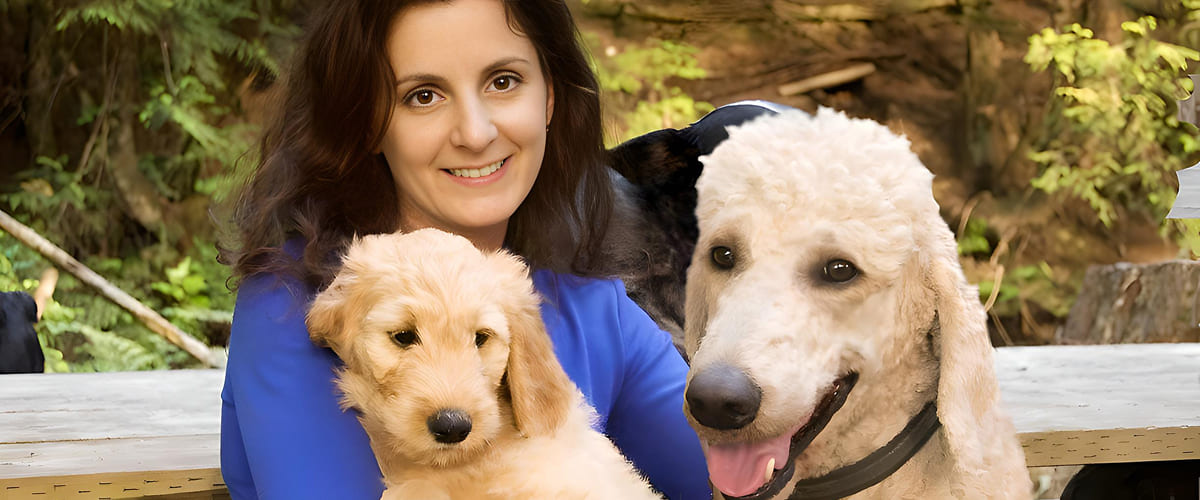
The mouse was running around the living room and my poodle, polka dot poodle, who is known, her real name is polka dot dazzle. And she's a beautiful white poodle. She's 38 pounds and she has little brown spots in the shape of hearts on her coat.
It's just gorgeous little dog and she's about five now. And even though she is one of my smaller dogs, she's the only dog I have now that has ever stood up to a bear full on. And she also likes to kill mice, which is a very odd habit for a poodle, but that's what she does.
She will find them in the forest, dig out a hole and then pick up some rodent and kill it. So anyway, that's happened twice. You might think it's an anomaly.
Why is she doing this? I don't know. You might know that 97% of the wolf and coyote diet in spring is rodent. So it's not unnatural for a dog to want to kill a mouse or kill a rat.
It's not unnatural at all and she doesn't eat them. But anyway, so this mouse went running down the stairs, stare, stare, stare, stare at me chasing it, broom in hand, broom broke, stare, stare, stare, stare, runs into the living room, hides behind the wood stove. And I say to polka dot, polka, get the mouse and she does.
She goes, she pushes a little bit with her head. This ottoman that it was hiding under. She grabs it.
She shakes it, killing it. She runs outside to the backyard and drops it on the back deck and doesn't doesn't want to do anything with it. I mean, it was perfect.
My little French maid, my little polka dot poodle just came and took that, took that mouse out. So cats, I don't know. I always thought you guys were good mousers.
But now, now I'm starting to wonder if maybe a good poodle is is better. Yeah. Yeah, it's a situation going on here.
I'm about to get some mousetraps because I think she may have released more than one that I don't know about and I don't like that idea. I'm sure you wouldn't either. No, no, I have a nice clean house.
I don't want a mouse in here. I wish the cats would understand that. Leave them outside.
Okay. So I'm going to remind you of our trivia question and then we're going to spend the rest of the show answering an email I got from a very upset grandpa. Okay.
So the trivia question is what did this bird get its foot caught in that they had to call it basically the veterinary version of Jaws of Life and and use a tranquilizer and involve other animal specialists from other fields to get the foot unstuck. Yeah. Okay.
So that's our question. But now we're going to go to break and come back and talk about autism and pets and why this grandpa was so upset when he showed up to visit his granddaughter. Stay tuned on Animal Party Pet Life Radio.
Hello, we're back on Animal Party on Pet Life Radio. What did that great blue heron get his foot stuck in? What? What do you think? Was it a human thing? Was it an animal thing? It's probably something alive because they had to call other specialists. Okay, so think about that and I will tell you the answer before the end of the show.
Okay. So this is the letter I'm going to read and it's a really long letter and it's written in very messy handwriting and it's been a long time since I got a letter like this. So they took a picture of the handwritten letter and then scanned it and sent it.
So the daughter sent me the letter that the grandpa that her dad wrote. So grandpa's writing the letter and it says maybe I'm wrong here, but jeez Louise. I went to see my granddaughter and she had no time for me.
No time at all. She was excited and I thought she was excited to see me, but she was not excited to see me. She was excited to get in the car and go read to a dog.
I told her I'd read to her. I'd read her a good story, but my daughter caused a big ruckus and wouldn't have any of it. They wouldn't even let me come along.
Can you explain to me why reading to a dog beats grandpa reading to a kid? Wow, poor grandpa. Oh my gosh, I do feel bad for grandpa. I do because his feelings were hurt and really this shouldn't be hurt because well, it's not that she likes the dog more than you and it's not that she would rather be read to by anybody else other than you.
It's that this is a completely different thing. So when an autistic kid is read to just like any kid they learn a lot by being read to absolutely, but that's a whole different skill than reading yourself. And even though in a kid who's doesn't have any learning challenges reading to them really helps them learn to read it does with autistic kids.
There's an extra component of embarrassment and the kids awareness that it's that maybe they're not performing at the level that grandpa's used to with the other grandkids or other adults are used to or that they've been embarrassed or made fun of before or they're just they're just not comfortable speaking to people. So the likelihood of this child reading to grandpa is very slim and that's what we're trying to do here. We're trying to get the kid speaking.
We're trying to get the kid reading not being read to but reading himself herself. So the granddaughter why would the granddaughter be so excited to see the dog? Well, that's a really good sign actually because some kids are kind of indifferent until they get going but they found with studies that where they compared kids who read to trained professionals who are trained not to react with frustration trained not to sigh trained not to be impatient trained not to take over for the kid, right? So so we're talking about trained professionals when the children read to train professionals. They compared that to when they read to dogs.
So that's not grandpa. I hate to say it but it's not grandpa. Grandpa's probably going to be too helpful.
Grandpa's probably going to take over even in his letter. He says he wants to read to her not that she should read to him. So that's the opposite skill.
So we're not looking for that right now. But even if grandpa could do all that and be just like the trained professionals not sigh, not get impatient, not fidget, not try to correct, right? Even if he could do all that he still wouldn't be as effective as a dog. The dogs have 25% more attendance rate.
Kids don't want to go when they're reading to a person but a hundred percent of the kids wanted to go when they were reading to a dog, right? When they were reading to a person only 75% of the kids wanted to go. So that's a big difference. And why is this? Well, for one thing there's the metabolics.
When anyone is with dogs, as long as they're not afraid of dogs, when anyone's with dogs their stress levels calm down. So they've actually measured this with autistic kids. When autistic kids read to dogs their blood pressure lowers and their cortisol levels lower.
So they have way less sensory stress. Touching the dog further helps that and some of the kids do it automatically. Some of the kids are coached to do it and then tend to keep doing it because the dog wags his tail and the dog reacts and again, these are trained dogs.
So for children who find eye contact or complex social cues overwhelming, the dogs are offering a form of communication that's way simpler. So it's like a social bridge and eventually they engage with the human facilitator who's with the dog the whole time. So it can be a really good grounding point.
It also helps kids with ADHD with focus and unlike humans what the magic is the dogs never correct. They never sigh, they never get impatient. It's unconditional.
It's positive. And so the child just focuses on learning to read and telling the story and so that the task goes from super high pressure to relaxed. That's what it's all about there.
So where can you find out about this? Well in my neighborhood, I was really surprised. I googled it and I got so many groups. There's Pet Partners.
There's Fraser Valley Regional Library. There's Vancouver Regional Library. There's Paws for Stories about like pet paw, Paws for Stories.
There's Read With Me. So if you're looking there's AutismAssistanceDog.com. There's Waggy Tails. Just Google it.
Just put it in your computer. Just use your phone and type in autistic kids read to dogs near me and you're going to get so many opportunities. So I really suggest this.
If you've got an autistic kid or a kid with ADHD or any kid who's having trouble reading see if you can get involved with this because it can really really make a difference and I'm sorry grandpa. I'm sorry your feelings were hurt, but maybe there's something else you can do with that granddaughter. Maybe you could pick her up after and take her somewhere else.
Take her to the zoo. Take her somewhere. She really loves to go.
All right, everybody. We're going to solve the riddle and end the show. So today's riddle.
What the heck happened to that great blue heron? Okay, so the great blue heron was doing what they do and it was trying to eat and it got it's this is in Vancouver British Columbia, Canada. So we have a big coast in the Pacific Ocean just like California or Washington State. So there it was doing its thing and they were protected birds.
So everybody was like really worried about it and it's it got its foot caught in an oyster a live oyster, but it wasn't just any oyster. This oyster was 18 centimeters long and 300 grams. It was a huge oyster.
It was like the King Kong of oysters. So but the oyster was still alive and the foot was caught in there. So in the end the bird lost two centimeters of a toe almost an inch.
Wow, but he's standing. Okay, and the oyster did die. Now you might hear this story and go.
Well, geez just shut the oyster. It's not so easy because the oyster if you don't do this carefully would clamp down when it died and that would probably sever the toe maybe make the bird unable to survive in the wild a perpetual, you know, captive animal or maybe even die. So no, no, no, no, we didn't want to do that.
So they had to call Marine people biologists and Marine vets to come in and figure out the right dose for the oyster so that it would be asleep so they could pry it open remove the foot and they were hoping the oyster would live although I mean it was going to be food if not, so it was kind of a marked a marked oyster, but no the oyster died in the freeing of the great blue heron, but the great blue heron survived and is standing and I just think that's amazing what people will do for one bird amazing. So yes, we have a female trainer who won the Derby. The beautiful horse called Golden Temple and we had an upset grandpa today who I hope is a little less upset when he realizes that there's absolute physical medical reasons kids with autism read better to dogs than grandpas.
Okay, someday she'll want to read to you if they keep going to the dog therapy someday. She'll be excited to read one of those books with you. And maybe maybe you could ask to attend one time not now when she's really good when she's been going for a while and she's really confident and then she could pick one of her easier books from before one of the first books she read and read that to the dog and you with the counselor because that's the way it's going to work.
All right, everybody from me Deb Wolf and Animal Party and Pet Life Radio be good dear animals. Ciao meow.